Real Betis vs Chelsea: Post-match analysis
Updated: Jun 19
Project Introduction:
A post-match analysis presentation created as part of my final assignment for the 'Advanced Performance Analysis' module in the MSc Sports Performance Analysis programme at Middlesex University, London. The tagging software used here is Catapult Focus (SBG) and all charts being displayed in the report is built via data collected by the tagging of events.

Fixture overview:
The fixture being analysed here is the 2024/2025 UEFA Conference League Final between Chelsea and Real Betis, played at the Tarczyński Arena in Wrocław, Poland on May 28th, 2025. The game ended 4-1 in Chelsea's favour with goals from Enzo Fernández, Nicolas Jackson, Jadon Sancho, and Moisés Caicedo. The post-match analysis focuses on the tactical setup picked by then-manager Enzo Maresca, before moving to the strengths and weaknesses displayed by Chelsea in this fixture.
Line-ups and Formations:
Both teams started in a 4-2-3-1 formation as shown below:

Enzo Maresca set up Chelsea by focusing on three important patterns of play – inverting the right back to overload the midfield, playing out from the back during build-up to break through Betis’s defensive lines, having numerical superiority in midfield and in attack, and counterpressing with a disciplined rest defence that prevented Real Betis from creating chances during transitions.
WHAT DID CHELSEA DO WELL?
Chelsea Strengths #01: Build-up patterns

Chelsea were adaptive and flexible in their build-up patterns, often adjusting to Betis’s defensive tactics and finding the spare man to break through their defensive lines and move the ball into the attacking third to create chances.
Chelsea used varying patterns during build-up, adjusting to Real Betis's defensive movement and aiming to find the spare man to progress the ball forward.
Pattern 1: Finding Cole Palmer and Enzo Fernandez in the half-spaces
Pattern 2: Switching play to unmarked wide players
Chelsea using this build-up pattern to find Cole Palmer in the right half-space directly led to Enzo Fernandez's equalizing goal in the 65th minute.
Chelsea’s Strength #02: Defensive Transitions

Chelsea adopted an aggressive counterpressing system focused on marking passing options after a turnover. Their tactics in defensive transition frequently led to chelsea winning possession, or in the very least preventing Real Betis from taking progressive actions, with Moises Caicedo playing a crucial role in leading the counterpress for Chelsea.
Chelsea’s Strength #03: Defending in wide areas

Another positive from Chelsea’s performance in this game was their ability to shut out passing options and apply pressure to the player on-the-ball when Betis held possession in the wide areas of the pitch. By triggering a press and marking short passing options, Chelsea often forced Betis to either make clearances or risk turning over possession in dangerous positions.
AREAS CHELSEA COULD HAVE PERFORMED BETTER IN
Chelsea weakness #01: Passive wingers
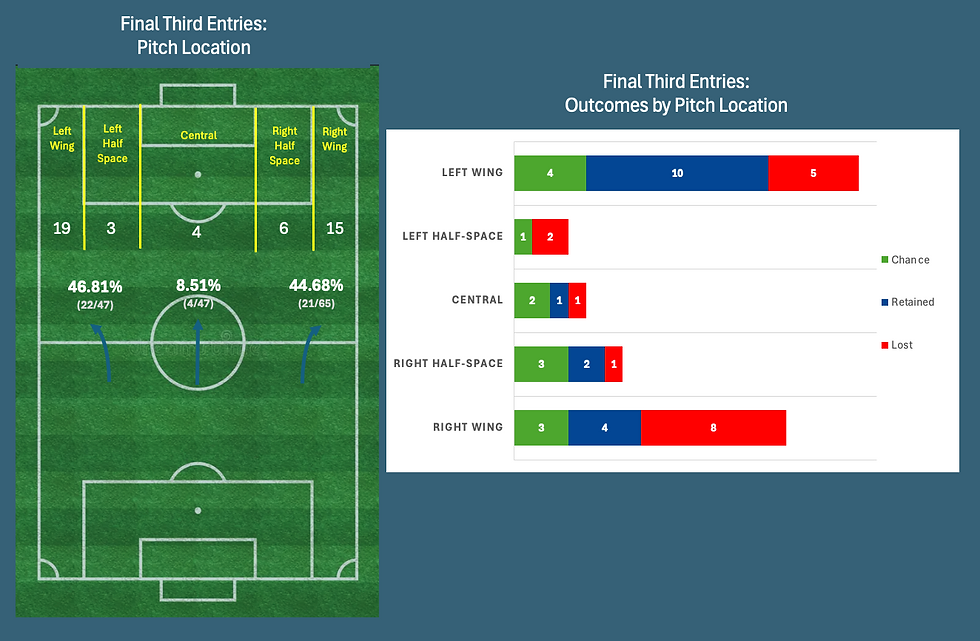
Chelsea's build-up patterns often created 1v1 situations for their wide players against the opposition full-back. However, Chlsea's wide players could have played with more intent in these situations by attempting to take-on and drive past their defenders to create chances. Instead, they frequently opted to hold possession and rotate the ball along the edge of the box to create space.
Chelsea Weakness #02: Underutilizing fast breaks

Chelsea often got into really good attacking positions when making fast breaks through the middle during attacking transitions. However, these fast breaks were underutilized by the players – either by slowing the play down and allowing the Real Betis players’ to recover and reorganize, or by making an error that prevents the chance to create a goal-scoring opportunity.
In fact, Chelsea scored their 3rd goal directly as a result of their fast break - further showing the need to utilize this transition tactic more effectively.
Chelsea weakness #03: Defensive transitions after turnovers in the middle third.
Real Betis exploited the space left behind by the right-back, Malo Gusto, when he inverts into the midfield during build-up play, especially during attacking transitions after turnovers in midfield.
Real Betis's goal in the 9th minute was a direct result of Real Betis taking advantage of a disorganized defensive line with Malo Gusto inverting into midfield.
Chelsea addressed this issue by substituting Malo Gusto with Reece James at half-time, whose defensive positioning and ability to recover is much stronger than Malo Gusto. The change drastically reduced the number of chances Real Betis were able to create down the left wing.

Conclusion:
Overall, Chelsea were tactically sound with a clear plan in place for how they wanted to approach this game against Real Betis. It took a lot of character from such a young team to go from being 1-0 down until the 65th minute to winning 4-1 by the final whistle. Manager Enzo Maresca's tactics of dominating possession, creating overloads in midfield, and counterpressing to prevent Real Betis from hitting Chelsea on the counter resulted in a strong Chelsea performance that helped them lift the UEFA Conference League trophy.



Comments